
Expert surgical repair of facial fractures and soft tissue injuries resulting from accidents, falls, or sports injuries. Serving patients from Dearborn, Troy, Wayne County, and across Metro Detroit, Dr. Hassan Nasser specializes in restoring your pre-injury appearance and preserving critical facial functions.
Understanding Facial Trauma Reconstruction
Facial trauma can be a highly distressing experience, impacting not only a person's appearance but also vital functions such as breathing, seeing, chewing, and speaking. Injuries can range from complex lacerations to severe fractures of the facial skeleton.
Effective reconstruction requires a deep understanding of the intricate anatomy of the face. Serving patients from Dearborn, Troy, and across Wayne County, Dr. Hassan Nasser approaches facial trauma with a dual focus: meticulously repairing the underlying bone structure to restore proper function, while utilizing advanced plastic surgery techniques to optimize the aesthetic outcome and minimize visible scarring. For complex jaw fractures, orthognathic alignment, or dental-implant stabilization, Dr. Nasser collaborates closely with trusted oral and maxillofacial surgeons in Metro Detroit, including Aria Oral Surgery.
What This Procedure Treats
Facial trauma reconstruction addresses a wide spectrum of injuries, including:
Facial Skeleton & Fracture Sites
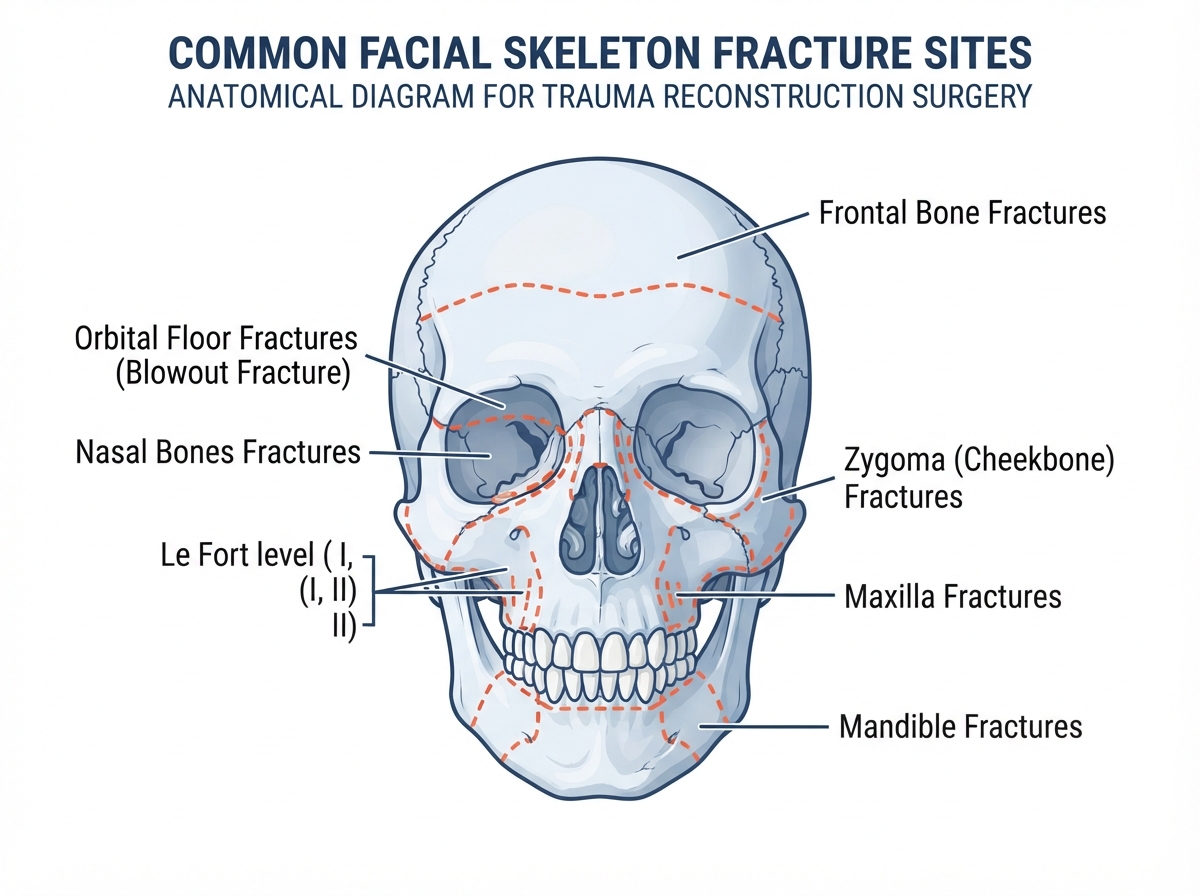
Facial skeleton showing common fracture sites addressed in trauma reconstruction. Tap each number to learn more.
- Nasal Fractures (Broken Nose)The most common facial fracture. Repair involves realigning the nasal bones to restore a straight appearance and clear the airway.
- Orbital Fractures (Eye Socket)Fractures around the eye can trap eye muscles (causing double vision) or cause the eye to sink backward. Repair restores the orbital volume and protects vision.
- Zygomaticmaxillary Complex (Cheekbone) FracturesFractures of the cheekbone can flatten the face and interfere with jaw movement. Repair restores facial width and projection.
- Mandible & Maxilla (Jaw) FracturesFractures of the upper or lower jaw require precise realignment (often using plates and screws) to ensure the teeth bite together correctly (occlusion).
- Complex Soft Tissue LacerationsDeep cuts involving muscles, nerves, or tear ducts that require meticulous, multi-layered repair to prevent functional deficits and excessive scarring.
Who is a Good Candidate?
You may require facial trauma reconstruction if you:
- Have sustained a recent injury resulting in facial fractures or severe lacerations.
- Are experiencing functional issues following trauma, such as double vision, difficulty chewing, or nasal obstruction.
- Have an older, healed facial injury that resulted in persistent deformity or functional impairment (requiring secondary reconstruction).
- Are medically stable following the initial trauma.
Your Evaluation
Evaluation of facial trauma often begins in the emergency room but requires specialized follow-up. During your evaluation, Dr. Nasser will:
- Review Imaging: Carefully analyze CT scans to identify the exact location and severity of all facial fractures.
- Assess Function: Evaluate your vision, eye movement, dental occlusion (bite), facial sensation, and facial nerve function.
- Determine Timing: Decide the optimal time for surgery. While some injuries require immediate repair, many are best treated a few days after the injury once initial swelling has subsided.
- Discuss the Surgical Plan: Explain the proposed incisions (often hidden) and the use of any plates or screws.
Procedure Overview
Facial trauma surgery is typically performed under general anesthesia. The specific techniques depend entirely on the nature of the injuries:
Fracture Repair (Open Reduction and Internal Fixation - ORIF)
Dr. Nasser makes precise incisions—whenever possible, hidden inside the mouth, inside the eyelid, or within the hairline—to access the broken bones. The bones are carefully realigned to their pre-injury position and stabilized using tiny titanium plates and screws. These implants are permanent but usually cannot be felt and do not require removal.
Nasal Fracture Reduction
For a simple broken nose, Dr. Nasser may perform a "closed reduction" within the first week or two of the injury, manually realigning the bones without incisions. If the injury is older or more severe, a formal rhinoplasty approach may be necessary to rebuild the nasal framework.
Soft Tissue Repair
Complex lacerations are meticulously cleaned (debrided) and repaired in multiple layers. Dr. Nasser uses fine sutures and plastic surgery techniques to ensure the edges are perfectly aligned, minimizing the resulting scar.
Recovery Timeline
Recovery from facial trauma surgery requires time and patience:
- 1First Few DaysSignificant swelling and bruising are typical and often peak 48-72 hours after surgery. You will likely be on a liquid or soft diet, especially if jaw fractures were repaired. Pain is managed with prescribed medications.
- 21-2 WeeksSwelling begins to decrease. Any external sutures or splints are usually removed during this time. Most patients can return to work or school, though they may still have visible bruising.
- 34-6 WeeksThe facial bones begin to heal solidly. You will gradually advance your diet back to normal foods as directed by Dr. Nasser. Strenuous exercise and contact sports must be avoided during this critical healing phase.
- 4Long-Term (6-12 Months)Residual, subtle swelling fully resolves. Facial sensation, which is often temporarily altered by trauma and surgery, usually normalizes. Scars continue to mature and fade.
Benefits
- ✓ Restoration of pre-injury facial appearance and symmetry.
- ✓ Protection and restoration of vision (orbital fractures).
- ✓ Restoration of normal dental occlusion (bite) and chewing function.
- ✓ Clearance of the nasal airway.
- ✓ Minimized visible scarring through hidden surgical approaches.
Potential Risks
- • Infection, particularly with fractures involving the sinuses or mouth.
- • Temporary or permanent numbness in the cheeks, lips, or teeth.
- • Hardware (plates/screws) becoming palpable or requiring later removal (rare).
- • Need for secondary surgery to address persistent functional or cosmetic issues.
Why Patients Choose Dr. Hassan Nasser
Facial trauma reconstruction requires a surgeon who understands both the rigid biomechanics of the facial skeleton and the delicate aesthetics of the soft tissue. Patients trust Dr. Nasser because of his:
- Comprehensive Training: Dual board-certified in Otolaryngology and fellowship-trained in Facial Plastic and Reconstructive Surgery, providing unparalleled expertise in facial anatomy.
- Aesthetic Focus: A commitment to utilizing hidden incisions (inside the mouth or eyelids) whenever possible to prevent visible facial scarring.
- Functional Priority: Ensuring that critical functions—like your bite, vision, and breathing—are fully restored alongside your appearance.
- Compassionate Care: Providing clear guidance and support during what is often a highly stressful period following an accident.
Educational Disclaimer
This content is provided by the practice of Dr. Hassan Nasser for general educational purposes only. It is not a substitute for professional medical advice, diagnosis, or treatment. Always seek the advice of your physician or other qualified health provider with any questions you may have regarding a medical condition. Individual results and recovery vary.
References & Sources
Preparing For Your Visit
To ensure a comprehensive evaluation of your injuries, please prepare the following:
- Imaging (Crucial): Bring physical copies (CDs/USBs) of any CT scans or X-rays taken in the emergency room. Do not rely solely on the written report.
- Medical Records: Bring any discharge summaries or notes from the emergency department or urgent care.
- Medication List: A complete list of current medications, especially any blood thinners or recent pain medications.
Resilience and Recovery After Facial Trauma
Facial trauma reconstruction helps patients recover both function and appearance after injury. Dr. Hassan Nasser's expertise in treating facial fractures and soft tissue injuries supports patients through every stage of healing, from emergency repair to final restoration.
With careful surgical planning, patients can achieve restored facial symmetry and return to their daily lives with confidence.

Frequently Asked Questions
Educational information regarding facial trauma reconstruction.
Expertise in Facial Reconstruction
If you have sustained a facial injury, specialized surgical care is essential to restore your appearance and preserve critical functions. Schedule a consultation with Dr. Hassan Nasser for a comprehensive evaluation.
