
Comprehensive, evidence-based surgical treatment for benign and malignant tumors of the head and neck. Dr. Hassan Nasser sees patients at Karmanos Cancer Center locations in Detroit, Dearborn, and Roseville, prioritizing complete tumor removal while preserving critical functions and quality of life.
Understanding Head & Neck Cancer Surgery
A diagnosis of a tumor in the head or neck region often brings significant anxiety and uncertainty. The head and neck house critical structures responsible for fundamental human functions, including breathing, swallowing, speech, and facial expression. Consequently, surgical intervention in this area requires an intricate understanding of anatomy, precise oncologic principles, and an unwavering commitment to functional preservation.
Head and neck cancer surgery encompasses a wide range of procedures designed to safely remove benign and malignant tumors. Dr. Hassan Nasser approaches each case with a dual focus: eradicating the disease to achieve clear surgical margins and utilizing advanced reconstructive techniques to restore form and function. This comprehensive approach ensures that patients not only receive evidence-based oncologic care but also experience the highest possible quality of life following treatment.
What This Procedure Treats
Head and neck cancers typically originate in the squamous cells that line the mucosal surfaces inside the mouth, nose, and throat. However, tumors can also develop in the salivary glands, thyroid, parathyroid, skin, and underlying soft tissues. Common conditions treated through head and neck surgical oncology include:
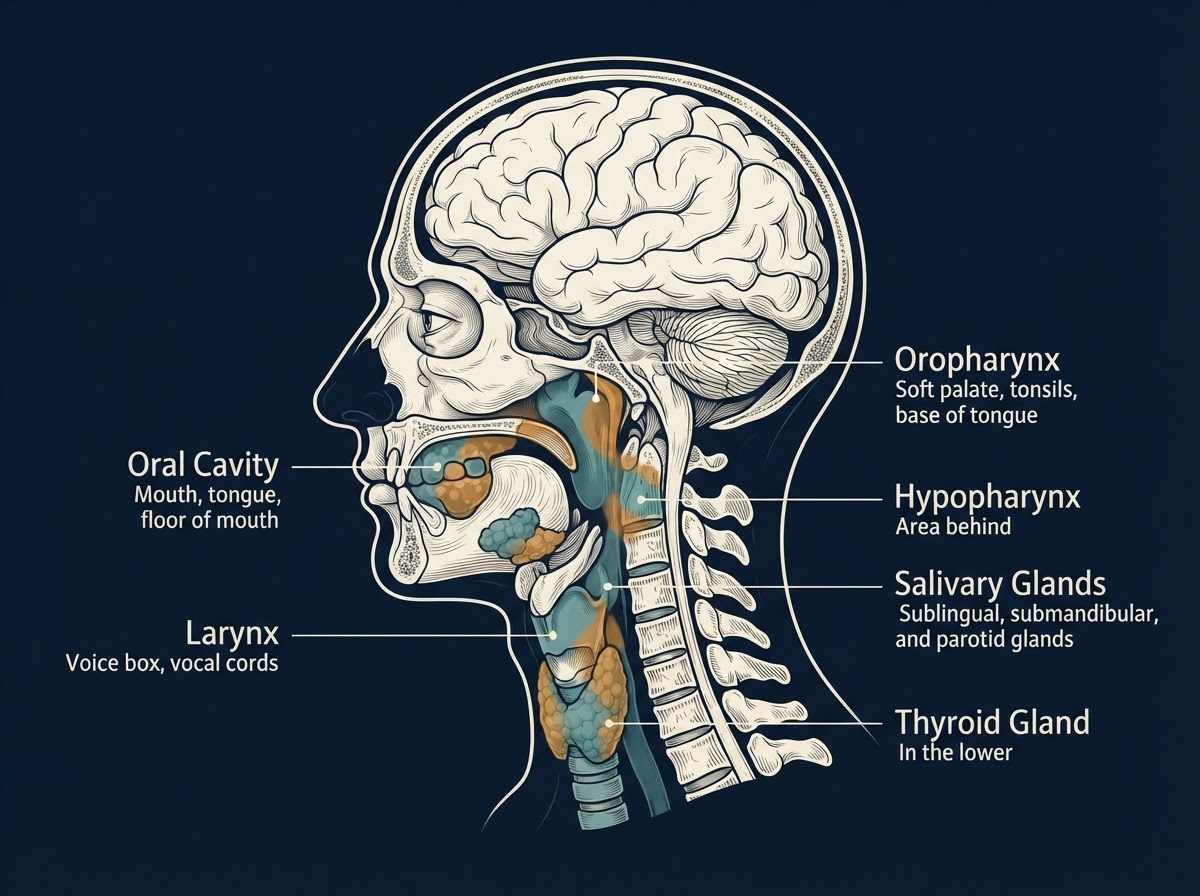
Anatomical regions of the head and neck where tumors may develop
- Oral Cavity Tumors: Cancers affecting the tongue, lips, gums, floor of the mouth, and hard palate.
- Oropharyngeal Cancers: Tumors located in the back of the throat, base of the tongue, and tonsils.
- Laryngeal and Hypopharyngeal Cancers: Malignancies involving the voice box and lower throat.
- Salivary Gland Tumors: Benign or malignant masses within the parotid, submandibular, or minor salivary glands.
- Thyroid and Parathyroid Disease: Nodules, goiters, and cancers requiring surgical management.
- Advanced Skin Cancers: Melanoma, Squamous Cell Carcinoma, and Basal Cell Carcinoma requiring complex resection and reconstruction.
Patients often seek evaluation when they notice persistent symptoms such as a sore throat that does not resolve, difficulty or pain when swallowing, a noticeable lump or mass in the neck, chronic hoarseness, or a sore in the mouth that fails to heal. Early evaluation by a specialist is critical for accurate diagnosis and effective treatment planning.
Who is a Good Candidate?
Surgical intervention is often a primary component of treatment for head and neck tumors, but candidacy depends on several highly individualized factors. Ideal candidates for head and neck cancer surgery generally include individuals who:
- Have a biopsy-confirmed diagnosis of a benign or malignant head and neck tumor.
- Are in sufficient overall health to safely undergo general anesthesia and tolerate a surgical procedure.
- Have a tumor that is anatomically resectable, meaning it can be removed safely without causing unacceptable damage to vital structures.
- Understand the goals of the surgery, potential risks, and the anticipated recovery process.
During your consultation, your complete medical history, current medications, lifestyle factors (such as tobacco or alcohol use), and nutritional status will be thoroughly evaluated to ensure that surgery is the safest and most appropriate path forward.
Your Consultation
A comprehensive consultation is the foundation of effective oncologic care. Dr. Nasser dedicates significant time to understanding your unique medical background, concerns, and personal goals. The consultation typically involves:
1. Comprehensive Evaluation
A detailed review of your medical history, previous treatments, and a thorough physical examination of the head and neck region. This may include flexible endoscopy to visualize the throat and vocal cords.
2. Review of Diagnostics
Dr. Nasser will personally review your imaging studies (such as CT scans, MRIs, or PET scans) and pathology reports to accurately stage the disease and determine its exact location and extent.
3. Multidisciplinary Planning
When appropriate, your case may be presented to a multidisciplinary tumor board. This collaborative approach ensures that surgical oncologists, radiation oncologists, medical oncologists, and pathologists align on the most effective, evidence-based treatment strategy.
4. Shared Decision Making
You will receive a clear, honest explanation of the proposed surgical approach, potential reconstructive options, risks, benefits, and expected recovery. Dr. Nasser encourages questions and ensures you are fully informed before proceeding.
Procedure Overview
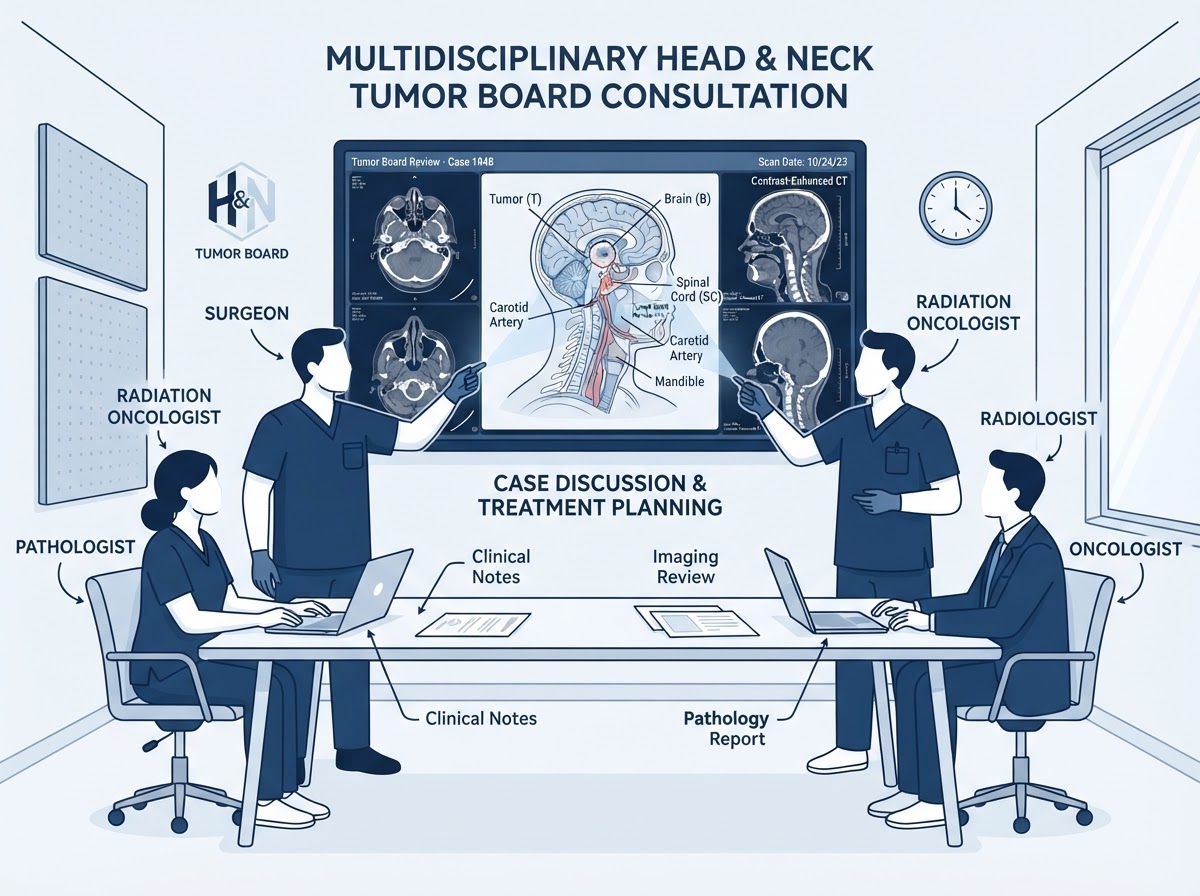
Multidisciplinary review of head and neck imaging guides evidence-based surgical planning
Head and neck cancer surgeries vary widely in scope, ranging from minimally invasive outpatient procedures to complex resections requiring extensive reconstruction and hospital stays. The overarching goals remain consistent: complete tumor removal, preservation of vital nerves and blood vessels, and optimal functional restoration.
Depending on the location and stage of the tumor, procedures may involve removing part of the tongue (Glossectomy), the voice box (Laryngectomy), the thyroid gland (Thyroidectomy), or affected lymph nodes in the neck (Neck Dissection).
Dr. Nasser’s fellowship training allows him to perform immediate reconstruction during the same operation. This may involve utilizing local tissue flaps or advanced microvascular free tissue transfer—moving skin, muscle, or bone from another part of the body to rebuild the jaw, throat, or facial structures. This integrated approach minimizes the number of surgeries required and accelerates the rehabilitation process.
Recovery Expectations
Recovery from head and neck surgery is a highly individualized process. Because these procedures often involve areas critical for breathing, eating, and speaking, rehabilitation is a key component of the postoperative phase.

With dedicated rehabilitation, many patients return to daily life and meaningful activities after recovery
Immediate Postoperative Period: Following major resections, patients typically spend several days in the hospital for close monitoring. You may have surgical drains to prevent fluid accumulation, and in some cases, temporary feeding tubes or tracheostomy tubes may be placed to assist with nutrition and breathing while swelling subsides.
Healing Timeline: Swelling, bruising, and mild discomfort are common and are managed with prescribed medications. Most patients can gradually resume light, non-strenuous activities within a few weeks. However, complete tissue healing and functional adaptation may take several months.
Rehabilitation: Dr. Nasser works closely with specialized speech and swallowing therapists to help patients regain function as quickly and safely as possible. Regular follow-up appointments are scheduled to monitor healing, remove sutures or drains, and ensure there are no signs of recurrence.
Benefits
- • Complete or maximal safe removal of cancerous tissue
- • Accurate pathological staging to guide further treatment
- • Relief from tumor-related symptoms (pain, obstruction)
- • Immediate reconstruction to preserve facial aesthetics
- • Preservation of critical speech and swallowing functions
- • Improved long-term survival and quality of life
Potential Risks
- • General risks of anesthesia and surgery (bleeding, infection)
- • Temporary or permanent changes in speech or swallowing
- • Numbness or changes in sensation near surgical sites
- • Facial nerve weakness (temporary or permanent)
- • Need for additional treatments (radiation, chemotherapy)
- • Healing delays or reconstructive flap complications
Alternative Treatment Options
Surgery is not the only modality used to treat head and neck tumors. Depending on the tumor's stage, location, and pathology, alternative or complementary treatments may be recommended. These include:
- Radiation Therapy: Often used as a primary treatment for certain early-stage throat or voice box cancers to preserve anatomy, or used postoperatively (Adjuvant Therapy) to eliminate microscopic disease.
- Chemotherapy or Immunotherapy: Systemic medications used in conjunction with radiation or surgery for advanced-stage tumors.
- Active Surveillance: For specific, very slow-growing, benign conditions (like certain small thyroid nodules), careful observation with regular ultrasound monitoring may be an appropriate initial strategy.
Dr. Nasser believes in a collaborative, multidisciplinary approach. If non-surgical management is deemed the most effective path for your specific condition, he will coordinate your care with trusted medical and radiation oncologists.
The Importance of Early Detection
Early detection and intervention are critical in head and neck cancer care. When diagnosed at an early stage, treatment options are typically broader and outcomes are generally more favorable. Individual prognosis varies based on specific pathology, tumor location, stage at diagnosis, and overall patient health. Dr. Nasser will discuss your specific situation and treatment options during your consultation.
Why Patients Choose Dr. Hassan Nasser
Selecting a surgeon for head and neck oncology is a critical decision. Dr. Nasser brings specialized fellowship training in both head and neck surgical oncology and microvascular reconstruction. This dual expertise allows him to manage complex tumor resections while simultaneously performing sophisticated reconstructions to restore facial aesthetics and vital functions.
His practice is built on a foundation of evidence-based medicine, transparency, and compassionate communication. Dr. Nasser prioritizes patient education, ensuring you fully understand your diagnosis and treatment options. By fostering a collaborative environment—both with his patients and with multidisciplinary medical teams—he provides comprehensive care designed to achieve the best possible long-term outcomes.
Educational Disclaimer
This content is provided by the practice of Dr. Hassan Nasser for general educational purposes only. It is not a substitute for professional medical advice, diagnosis, or treatment. Always seek the advice of your physician or other qualified health provider with any questions you may have regarding a medical condition. Individual results and recovery vary.
Preparing For Your Consultation
To ensure your consultation is as productive and informative as possible, we recommend arriving prepared with the following information:
Medical Records
Please bring copies of any recent imaging (CT, MRI, PET scans on a disc), biopsy reports, and pathology results related to your condition.
Medication List
Compile a complete list of your current medications, including prescriptions, over-the-counter drugs, vitamins, and supplements.
Questions to Ask
Write down any questions or concerns you have regarding your diagnosis, surgical options, risks, and the expected recovery timeline.
Insurance Info
Bring your current insurance cards and identification. Our office staff will assist you in understanding your coverage and coordinating care.
Patient Education & Resources
We believe that informed patients make the best decisions regarding their healthcare. Explore our additional resources to learn more about related procedures, recovery guidelines, and practice information:
Frequently Asked Questions
Key Focus Areas
- Complete tumor resection
- Functional preservation
- Multidisciplinary approach
- Advanced reconstructive options
- Evidence-based protocols
Experience the difference of specialized care.
Contact our office today to schedule your consultation with Dr. Nasser and learn more about head and neck surgical oncology options.
Contact Us Today